
Asia/Jakarta
Projects

Building a City Government Website with Next.js and Backend-for-Frontend Architecture

Building a City Government Website with Next.js and Backend-for-Frontend Architecture
December 6, 2025
GitHub Repository:
Bash
git clone https://github.com/Afrizal236/page-wisata-surabaya.go.id.git
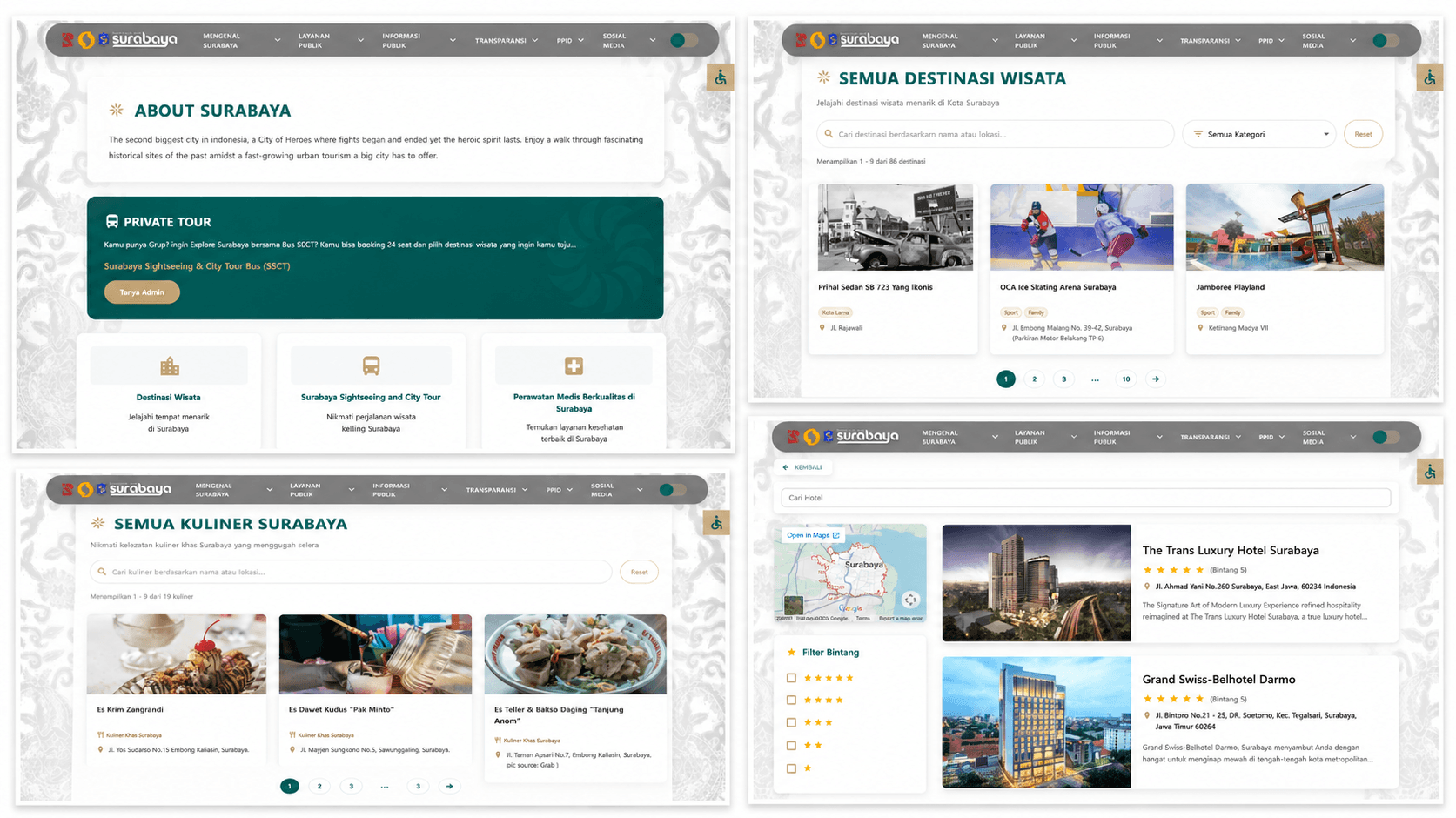
Building a personal portfolio website is straightforward. Building an official city government platform that serves millions of citizens — with real-time news, tourism information, event calendars, media galleries, and accessibility features, all proxied securely through a server-side layer — that is where frontend engineering meets public infrastructure. surabaya.go.id bridges this gap — the official frontend for the City of Surabaya built with Next.js 13, using a Backend-for-Frontend (BFF) pattern to proxy internal APIs securely before delivering data to the browser. Every page, from breaking news to tourist destinations, flows through a controlled server-side layer that handles authentication signatures and data normalization. This article covers the complete architecture: from BFF proxy design and React Query data fetching to Docker deployment and component organization.
+----------------+     +----------------+     +----------------+
|    Browser     |     |   Next.js BFF  |     |   Backend APIs |
|                |     |                |     |                |
| Pages &        |---->| API Routes     |---->| Surabaya API   |
| Components     |     | /api/data/     |     | BASE_API_URL   |
|                |     |                |     |                |
| React Query    |     | Axios + Sign   |     | WebDisplay API |
| TanStack       |     | Header Proxy   |     | API_URL_WD     |
+----------------+     +----------------+     +----------------+

Env
# Primary backend API
API_URL=http://surabaya.go.id/api/

# WebDisplay API
API_URL_WEBDISPLAY=https://webdisplay.surabaya.go.id/api/

# Public image base URL (available in browser)
NEXT_PUBLIC_IMG=https://surabaya.go.id

# Internal backend URL (server-side only)
BASE_API_URL=http://<internal-ip>:<port>/api/v1/

# Security signature for backend authentication
SIGNATURE=<your-signature-hash>

# City identifier
SBY_ID=1
SURABAYA_SLUG=surabaya.go.id
frontend/
├── components/         # Reusable UI components
│   ├── header.tsx
│   ├── footer.tsx
│   ├── layout.tsx
│   ├── home.section1.tsx ... home.section7.tsx
│   ├── carousel.*.tsx
│   ├── news.*.tsx
│   ├── media.*.tsx
│   ├── wisata.tsx
│   ├── infografis.*.tsx
│   ├── search.tsx
│   ├── pagination.tsx
│   └── accessibility.tsx
├── pages/
│   ├── index.tsx
│   ├── berita/
│   ├── agenda/
│   ├── wisata/
│   ├── infografis/
│   ├── photos/
│   ├── videos/
│   ├── podcasts/
│   └── api/data/       # BFF proxy layer
│       ├── news.tsx
│       ├── agenda.tsx
│       ├── menu.tsx
│       └── webdisplay.tsx
├── hooks/
├── contexts/
├── types/
└── utils/
    ├── axios.config.tsx
    └── services/

The BFF layer sits between the browser and the internal Surabaya backend APIs. All client requests go through Next.js API Routes — the internal API URLs and signature keys are never exposed to the browser.
Typescript
// utils/axios.config.tsx
import axios, { AxiosInstance } from 'axios';

const axiosConfig = (useInternalApi: boolean): AxiosInstance => {
  const baseURL = useInternalApi
    ? process.env.BASE_API_URL
    : process.env.API_URL_WEBDISPLAY;

  return axios.create({
    baseURL,
    headers: {
      'Signature': process.env.SIGNATURE,
      'Content-Type': 'application/json',
    },
  });
};

// Use internal Surabaya backend
export const apiClient    = axiosConfig(true);

// Use WebDisplay backend
export const wdApiClient  = axiosConfig(false);
Typescript
// pages/api/data/news.tsx
import type { NextApiRequest, NextApiResponse } from 'next';
import { apiClient } from '@/utils/axios.config';

export default async function handler(
  req: NextApiRequest,
  res: NextApiResponse
) {
  try {
    const { category, page = 1, limit = 10 } = req.query;

    const response = await apiClient.get('/news', {
      params: { category, page, limit },
    });

    res.status(200).json(response.data);
  } catch (error) {
    res.status(500).json({ message: 'Failed to fetch news' });
  }
}

React Query manages all server state — caching, background refetching, and loading states — so components stay clean and declarative.
Typescript
// utils/services/news.tsx
import axios from 'axios';

export interface NewsParams {
  category?: string;
  page?: number;
  limit?: number;
}

export const getNewsList = async (params: NewsParams) => {
  const response = await axios.get('/api/data/news', { params });
  return response.data;
};

export const getNewsDetail = async (slug: string) => {
  const response = await axios.get(`/api/data/news/${slug}`);
  return response.data;
};
Typescript
// pages/berita/index.tsx
import { useQuery } from '@tanstack/react-query';
import { getNewsList } from '@/utils/services/news';

const BeritaPage = () => {
  const { data, isLoading, isError } = useQuery({
    queryKey: ['news', { category: 'all', page: 1 }],
    queryFn:  () => getNewsList({ category: 'all', page: 1 }),
    staleTime: 5 * 60 * 1000, // cache for 5 minutes
  });

  if (isLoading) return <LoadingSpinner />;
  if (isError)   return <ErrorMessage />;

  return <NewsList articles={data.articles} />;
};

The application uses Next.js file-based routing with dynamic segments for detail pages.
/                        Home page
/berita                  News list
/berita/[slug]           News detail
/agenda                  City events list
/wisata                  Tourism information
/infografis              Infographics list
/photos                  Photo gallery
/videos                  Video gallery
/podcasts                Podcast gallery
/api/data/news           BFF: news proxy
/api/data/agenda         BFF: agenda proxy
/api/data/menu           BFF: navigation menu proxy
/api/data/webdisplay     BFF: webdisplay proxy
Typescript
// pages/berita/[slug].tsx
import { GetServerSideProps } from 'next';
import { getNewsDetail } from '@/utils/services/news';

export const getServerSideProps: GetServerSideProps = async ({ params }) => {
  const slug = params?.slug as string;

  try {
    const article = await getNewsDetail(slug);
    return { props: { article } };
  } catch {
    return { notFound: true };
  }
};

Typescript
// components/layout.tsx
import Header from './header';
import Footer from './footer';

interface LayoutProps {
  children: React.ReactNode;
}

const Layout = ({ children }: LayoutProps) => {
  return (
    <>
      <Header />
      <main>{children}</main>
      <Footer />
    </>
  );
};
| Component | Function | |---|---| | layout.tsx | Main page wrapper with header and footer | | header.tsx | Main navigation and menu | | carousel.main.tsx | Hero carousel on home page | | news.list.tsx | Article list with categories | | news.detail.redesign.tsx | Full article detail view | | wisata.tsx | Tourism destination list | | destination.tsx | Single destination detail | | media.player.video.tsx | Embedded video player | | media.player.audio.tsx | Podcast and audio player | | infografis.list.tsx | Infographic gallery | | search.tsx | Site-wide search | | pagination.tsx | Page navigation | | accessibility.tsx | Accessibility tools for disabled users | | popper.share.tsx | Social media share button |
The project ships with a multi-stage Dockerfile and Docker Compose configuration for production deployment.
Yaml
version: "3.8"
services:
  surabaya-frontend:
    build: .
    container_name: surabaya-frontend
    ports:
      - "3005:3005"
    env_file:
      - .env.production
    volumes:
      - /media/HDNFS/surabaya/uploads/images:/app/public/images
    restart: always
Dockerfile
# Stage 1: Dependencies
FROM node:18-alpine AS deps
WORKDIR /app
COPY package.json yarn.lock ./
RUN yarn install --frozen-lockfile

# Stage 2: Build
FROM node:18-alpine AS builder
WORKDIR /app
COPY --from=deps /app/node_modules ./node_modules
COPY . .
RUN yarn build

# Stage 3: Production runner
FROM node:18-alpine AS runner
WORKDIR /app
ENV NODE_ENV production
COPY --from=builder /app/.next/standalone ./
COPY --from=builder /app/public ./public
EXPOSE 3005
CMD ["node", "server.js"]
| Parameter | Value | |---|---| | Base Image | node:18-alpine | | Exposed Port | 3005 | | Output Mode | standalone (Next.js) | | Volume | uploads/images mapped to public/images | | Restart Policy | always |
Tune stale time per data type — news changes frequently, menus almost never:
Typescript
// News: short cache, changes often
useQuery({
  queryKey: ['news'],
  queryFn: getNewsList,
  staleTime: 2 * 60 * 1000,  // 2 minutes
});

// Navigation menu: long cache, rarely changes
useQuery({
  queryKey: ['menu'],
  queryFn: getMenu,
  staleTime: 60 * 60 * 1000, // 1 hour
});
Javascript
// headers.js — HTTP security headers
const securityHeaders = [
  { key: 'X-DNS-Prefetch-Control',  value: 'on' },
  { key: 'X-Frame-Options',         value: 'SAMEORIGIN' },
  { key: 'X-Content-Type-Options',  value: 'nosniff' },
  { key: 'Referrer-Policy',         value: 'strict-origin-when-cross-origin' },
];

module.exports = securityHeaders;

The journey from a blank Next.js project to a production-ready city government platform requires architectural discipline at every level — from keeping internal API credentials server-side in a BFF layer, to organizing dozens of components across news, tourism, media, and civic services without losing maintainability. The key lesson from surabaya.go.id: the BFF pattern is not optional for public government platforms. Exposing internal API URLs and signature keys directly to the browser is a security risk no civic platform can afford. Proxy everything through the server, cache aggressively with React Query, and ship with Docker so the infrastructure is as reliable as the product.