Asia/Jakarta
Posts

A Web App That Helps Indonesian Students Write Formal Messages

A Web App That Helps Indonesian Students Write Formal Messages
September 10, 2024
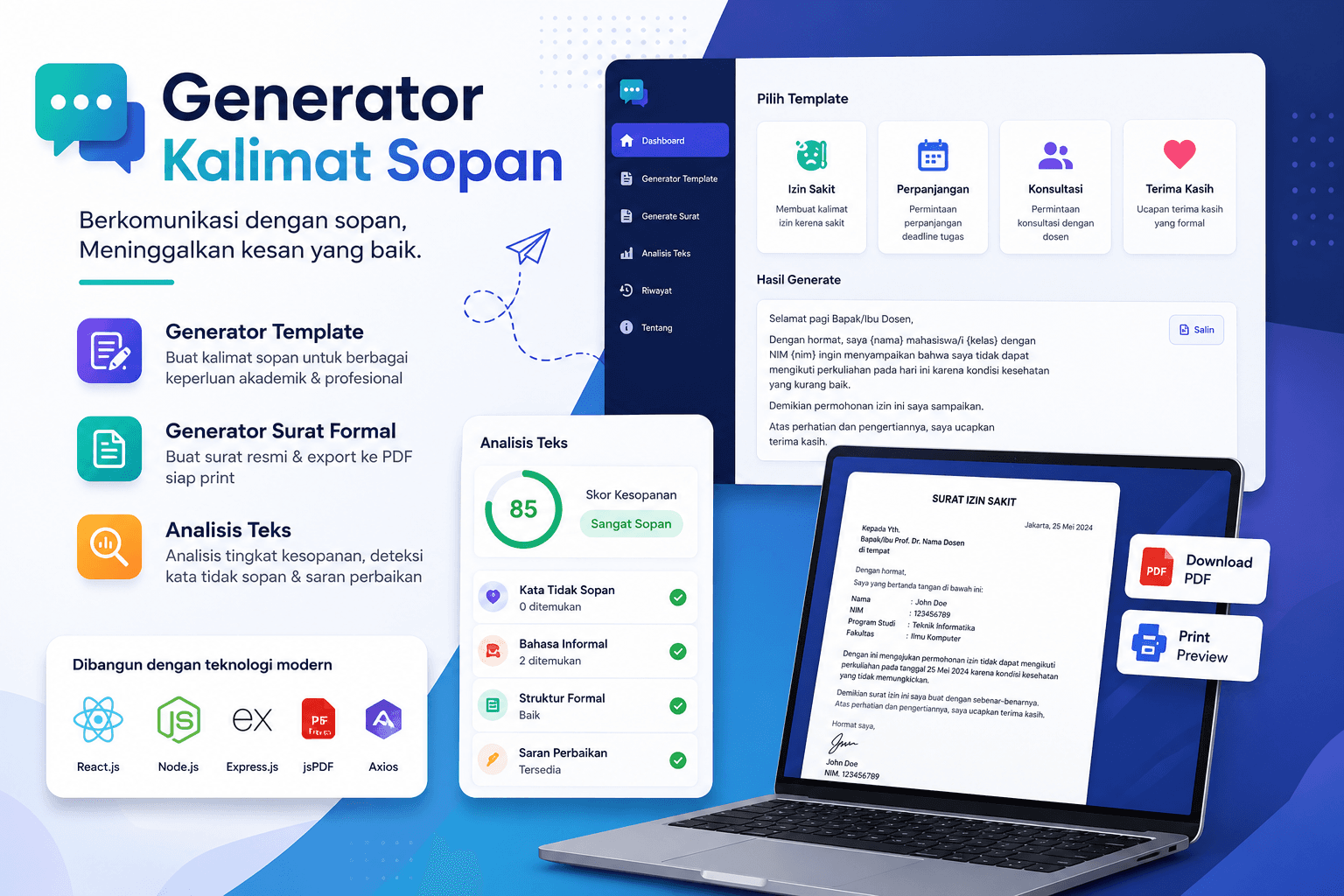
Who hasn't been in this situation? You need to ask your lecturer for a deadline extension, but you're not sure how to phrase it politely. You type and retype, second-guessing every word. Is this too casual? Too stiff? Will it come across as rude? This is a real and common problem for Indonesian university students — and it's exactly what Generator Kalimat Sopan solves. A web application that helps students and professionals craft formal, polite, and contextually appropriate messages to lecturers and superiors — instantly. Generator Kalimat Sopan is divided into three core modules, each targeting a different communication need: Template Generator is the quickest way to get a polished sentence. Users pick a scenario — sick leave, deadline extension, consultation request, or thank you — fill in their personal details like name, NIM, class, and lecturer's name, and the app instantly generates a complete, contextually appropriate polite sentence ready to copy and send. Formal Letter Generator takes it a step further. For situations that require an official written document, this module produces a fully formatted formal Indonesian academic letter. Users select the letter type, complete the required fields, and receive a print-ready document that can be downloaded as a PDF or printed directly from the browser via the built-in print preview feature. Text Analyzer is the most intelligent part of the application. Users paste any message they've written and the system runs a politeness analysis, returning a score from 0 to 100. The analyzer detects inappropriate words (penalizing up to -40 points per word), informal language (-3 to -10 points per word), and checks for the presence of proper formal structure like greetings and closings (-15 points if missing). Beyond scoring, it flags the specific problematic words, explains why they're unsuitable, and offers both manual suggestions and an automatic rewrite in formal Indonesian. The scoring system is designed to give users actionable, not just numerical, feedback:
  • 80–100: The text is highly formal and appropriate to send as-is.
  • 60–79: Minor adjustments recommended — usually a word or two.
  • 0–59: Significant revision needed before the message is suitable.
This project is a full-stack web application built with a React frontend and a Node.js + Express backend: Frontend:
  • React.js — Component-based UI for the three main tabs
  • CSS3 — Responsive design with gradient styling
  • jsPDF — Client-side PDF generation for formal letter export
  • Axios — HTTP client for communicating with the backend API
Backend:
  • Node.js + Express.js — REST API server handling template generation, letter rendering, and politeness analysis logic
  • CORS + dotenv — Cross-origin support and environment configuration
This project is a solid foundation for a broader communication assistant. Some features that could be added later:
  • Support for regional Indonesian languages (Javanese, Sundanese).
  • Export to Word (.docx) and HTML formats.
  • Improved NLP-based politeness scoring beyond keyword matching.
  • Mobile-first redesign for on-the-go use.
  • Integration with WhatsApp or email for direct sending.
Communicating professionally is a skill — and like any skill, it can be learned. Generator Kalimat Sopan makes that process easier, one polite sentence at a time. Building Generator Kalimat Sopan was a reminder that the best software solves problems people actually face every day. The challenge of writing a polite, formal message to a lecturer might seem trivial from the outside — but for many Indonesian students, it's a genuine source of anxiety that affects how they communicate and advocate for themselves academically. What made this project technically interesting was the text analysis engine. Building a rule-based scoring system that doesn't just flag bad words but actually understands formality levels, structural completeness, and context — and then suggests specific improvements — pushed the backend logic well beyond a simple CRUD application. The combination of React on the frontend and Node.js + Express on the backend proved to be the right choice for this kind of interactive, real-time tool. jsPDF in particular was a satisfying addition — giving users a tangible, print-ready output made the whole experience feel complete and practical rather than just a demo. If there's one takeaway from this project, it's that communication tools built for a specific cultural and academic context will always outperform generic alternatives. A tool that understands Indonesian academic etiquette, knows the difference between formal and informal Bahasa Indonesia, and produces output that actually sounds human — that's the kind of specificity that makes software genuinely useful.
On this page