Asia/Jakarta
Posts

Real-Time ASL Hand Gesture Recognition Using MediaPipe and Geometric Landmark Analysis

Real-Time ASL Hand Gesture Recognition Using MediaPipe and Geometric Landmark Analysis
August 22, 2025
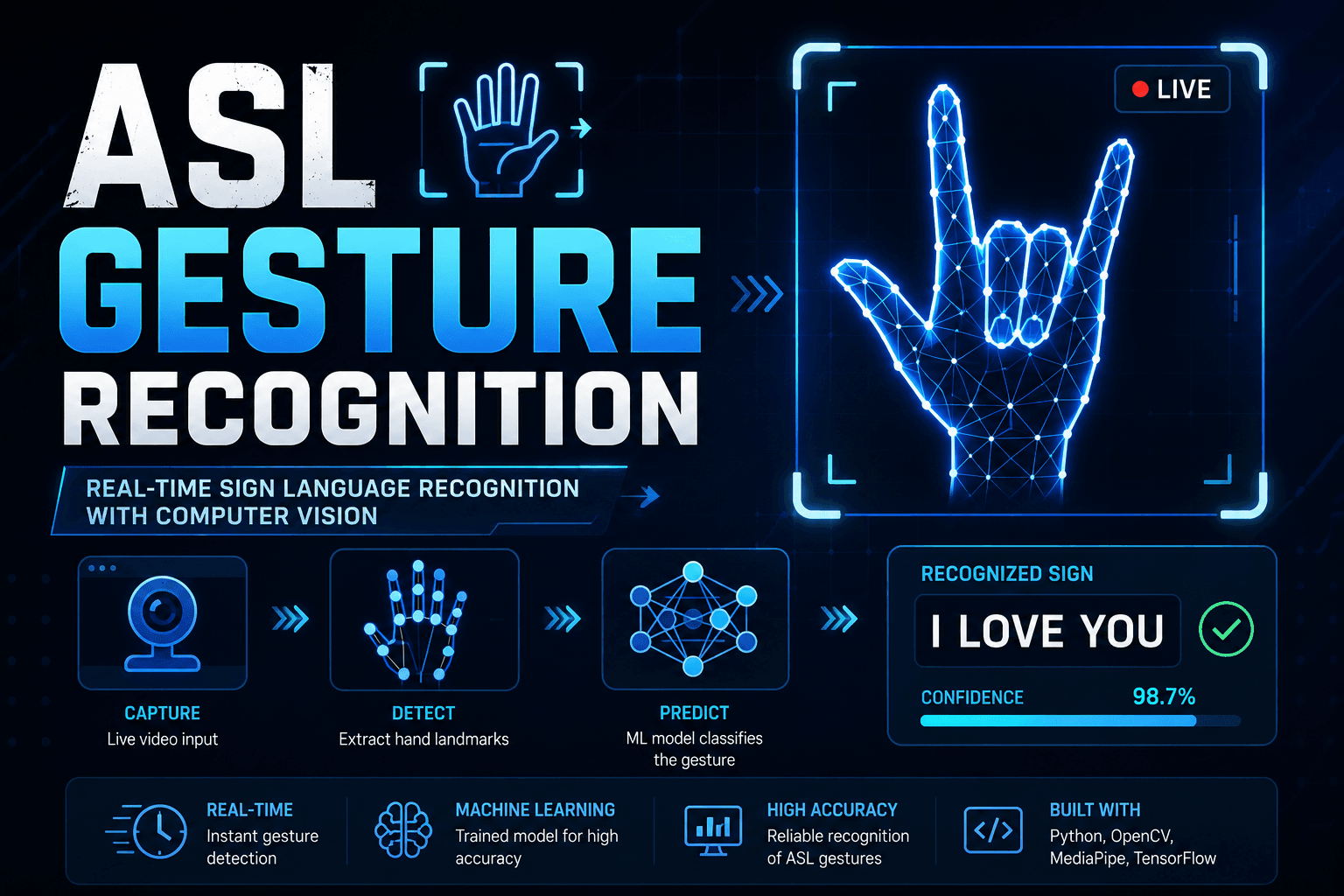
Computer vision has undergone a revolution in the past decade, driven almost entirely by real-time landmark detection. While traditional approaches required training massive datasets to recognize hand shapes, modern solutions like MediaPipe can track 21 precise hand landmarks at 60+ FPS — no GPU required. The ASL Hand Gesture Recognition project leverages this capability to classify American Sign Language (ASL) hand gestures from A to Z in real-time using a webcam. Instead of a neural network classifier, this project uses a purely geometric rule-based approach — analyzing the spatial relationships between hand landmarks to determine which letter is being signed. A typical approach to gesture recognition would be to train a classification model on thousands of labeled hand images. But this project takes a different — and arguably more elegant — path: geometric reasoning directly on landmark coordinates. MediaPipe provides 21 landmark points per hand, each with x, y, z coordinates. By analyzing the relative positions of fingertips, PIP joints, and MCP joints, we can determine:
  • Which fingers are extended or folded
  • Whether the thumb is pointing sideways, crossing over, or tucked under
  • The exact spatial relationship between the thumb and each finger
This approach requires zero training data, runs instantly, and is fully explainable — you can read exactly why the model thinks a gesture is "A" versus "S". Every letter check is a pure geometric function over the 21 landmarks:
Python
def finger_up(landmarks, finger):
    """Jari terangkat — ujung lebih tinggi dari PIP joint."""
    tip = get_lm(landmarks, FINGER_TIPS[finger])
    pip = get_lm(landmarks, FINGER_PIPS[finger])
    return tip[1] < pip[1] - 0.02  # y lebih kecil = lebih tinggi di layar

def finger_curled_tight(landmarks, finger):
    """Jari menekuk penuh — ujung mendekati telapak."""
    tip = get_lm(landmarks, FINGER_TIPS[finger])
    mcp = get_lm(landmarks, FINGER_MCPS[finger])
    return tip[1] > mcp[1] - 0.01
The most technically challenging part of the project is correctly distinguishing five letters that all share the same base shape — a tight fist: A, S, T, M, and N. The only difference between them is where the thumb sits relative to the fingers. This required designing five dedicated geometric helpers:
Python
def thumb_beside_index(landmarks):
    """A — ibu jari keluar ke samping, sejajar MCP telunjuk."""
    t4 = get_lm(landmarks, 4)   # ujung ibu jari
    t5 = get_lm(landmarks, 5)   # MCP telunjuk
    dx = abs(t4[0] - t5[0])
    dy = t4[1] - t5[1]
    vertical_aligned = abs(t4[1] - get_lm(landmarks, 6)[1]) < 0.12
    return dx > 0.07 and dy > -0.06 and vertical_aligned

def thumb_between_index_middle(landmarks):
    """T — ibu jari menyembul di sela telunjuk dan jari tengah."""
    t4  = get_lm(landmarks, 4)
    t6  = get_lm(landmarks, 6)   # PIP telunjuk
    t10 = get_lm(landmarks, 10)  # PIP jari tengah
    below_index_pip = t4[1] > t6[1] - 0.02
    x_min = min(t6[0], t10[0]) - 0.03
    x_max = max(t6[0], t10[0]) + 0.03
    return below_index_pip and x_min < t4[0] < x_max and dist(t4, t6) < 0.14

def thumb_under_three_fingers(landmarks):
    """M — ibu jari tersembunyi di bawah 3 jari."""
    t4  = get_lm(landmarks, 4)
    t6  = get_lm(landmarks, 6)
    t10 = get_lm(landmarks, 10)
    t14 = get_lm(landmarks, 14)
    return (t4[1] > t6[1] and t4[1] > t10[1] and t4[1] > t14[1] - 0.02)
The order of gesture checks in the GESTURES list is critical — more specific gestures (M, T, N) must be checked before more general ones (S, A, E) to prevent false positives:
Python
GESTURES = [
    # ... other letters ...
    ('M', 'Ibu jari di bawah 3 jari',              check_M),  # most specific
    ('T', 'Ibu jari di sela telunjuk+tengah',       check_T),
    ('N', 'Ibu jari di bawah 2 jari',               check_N),
    ('S', 'Kepalan + ibu jari di depan',            check_S),
    ('A', 'Kepalan + ibu jari di samping',          check_A),  # least specific
    ('E', 'Semua jari tekuk penuh',                 check_E),
]
Raw frame-by-frame detection is noisy — a gesture might flicker between letters during transition. To solve this, a stability counter is used: a letter is only confirmed after it has been detected consistently for at least 2 consecutive frames, and confidence grows the longer the gesture is held:
Python
if detected_letter == last_letter:
    stable_frames += 1
else:
    stable_frames = 0
    last_letter = detected_letter

confidence = min(100, 30 + stable_frames * 10)

if stable_frames >= 2:
    current_letter = detected_letter
  • Python: Core language for all gesture logic and application orchestration.
  • MediaPipe: Google's real-time hand tracking solution, providing 21 3D landmarks per hand at high FPS with no GPU required.
  • OpenCV: Handles webcam capture, frame flipping, landmark visualization, and the real-time UI overlay rendering.
  • NumPy: Powers all coordinate math — distance calculations, positional comparisons, and geometric reasoning between landmarks.
The biggest challenge was designing geometric rules precise enough to distinguish visually similar gestures — particularly the fist group (A, S, T, M, N) where the only differentiator is a few millimeters of thumb position. This required multiple iterations of threshold tuning and careful ordering of gesture checks to prevent cascading false positives. The stabilization system was also a key lesson: raw detection is inherently noisy, and a small confidence buffer dramatically improves the perceived reliability of the system. Overall, this project proved that rule-based geometric reasoning can be a powerful and transparent alternative to black-box neural network classifiers for well-defined spatial recognition tasks. The full source code is available on GitHub. Feel free to view, download, or develop it further.
Bash
git clone https://github.com/Afrizal236/Unity-Endless-Game-Runner.git
On this page